
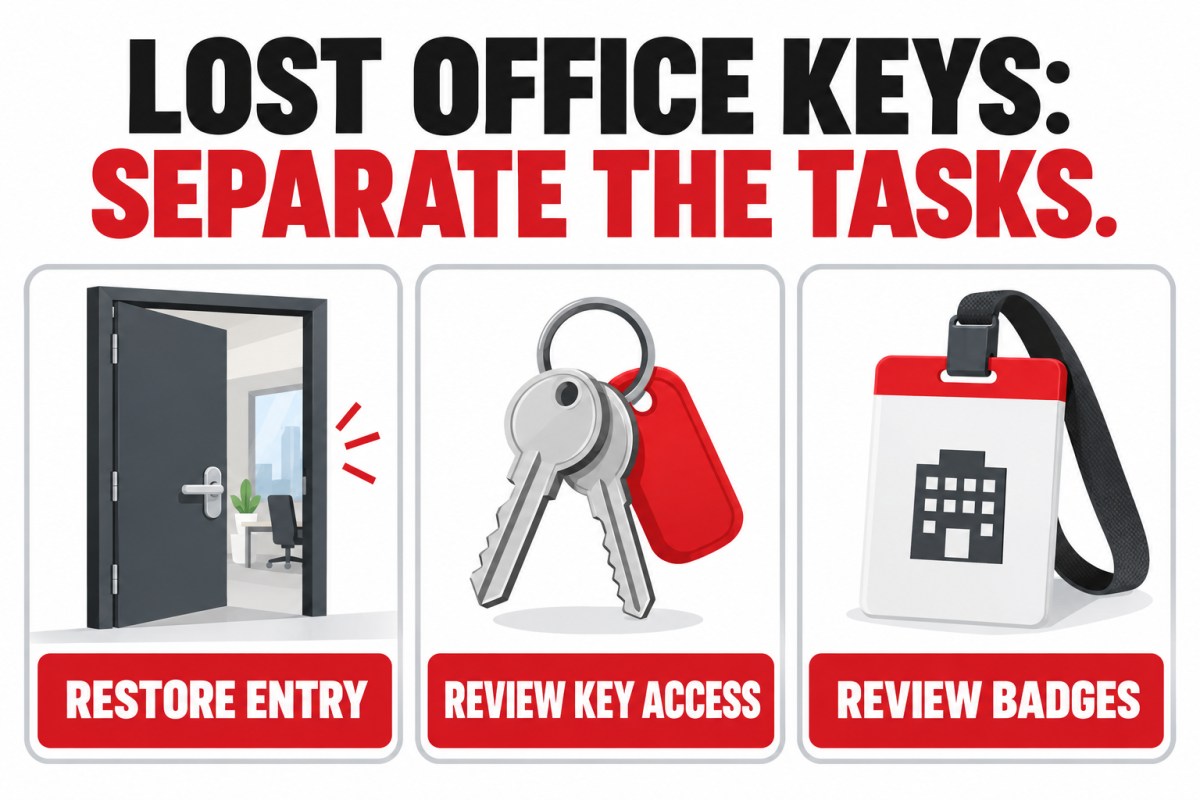
Lost office keys call for an access review, even if a spare lets you open the door. Notify the responsible manager, identify the openings the missing keys operate, and decide who can authorize changes. Restoring entry and preventing use of the missing keys are separate tasks that should be scoped clearly.
This checklist helps Tucson business owners and facility managers coordinate a practical response. It focuses on the information needed for a decision, rather than assuming every lost key requires replacing every lock in the building.
Lost office keys: establish who controls the response
Start with the person responsible for the space: the business owner, authorized manager, landlord, or building security contact. A staff member who needs to get inside may not have authority to change a shared entrance. Avoid arranging conflicting visits without one person coordinating the scope.
Record the last confirmed use, the approximate loss circumstances, and what was on the keyring. Keep that information within the agreed incident process. If theft or suspicious activity is suspected, use the organizational reporting procedure and contact the appropriate authorities when warranted; do not make unsupported accusations.
| Question | Why it matters | Useful record |
|---|---|---|
| Which openings do the keys operate? | The affected area defines the access review | A list held by the responsible manager |
| Were badges or identifying labels also lost? | Mechanical and electronic access may need separate action | Credential identifiers recorded privately |
| Is there a working authorized spare? | Entry assistance may be separate from access changes | Who can provide controlled access for service |
| Who approves shared hardware changes? | A lease or building arrangement may govern the work | The designated owner or manager contact |
Map affected access without publicizing it
Check organizational key records and ask the responsible custodian to identify relevant openings. Do not publish photographs of key cuts, lock locations, or a detailed access map. An incident summary can tell the provider enough to begin a conversation without exposing the full security arrangement.
Labels can make keys convenient to identify but may reveal where a lost key belongs. Falcon’s key-control information discusses the tradeoff between visible identification and concealed records. Use that to review your own labeling practice, not as proof that every labeled key creates the same risk.
Compare entry assistance with access changes
If nobody can open the office through an authorized method, the immediate request may involve entry assistance. If a spare already works, the discussion may instead focus on whether the missing key should remain valid. Explain both needs so the estimate does not solve only the first problem.
Tucson Locksmith Experts LLC lists lock repair and replacement, access control, and lockout assistance on its commercial locksmith page. Ask which services fit the actual hardware and what authorization is needed. A service menu cannot determine the response without understanding the affected opening.
Rekeying versus replacing hardware
Where suitable and offered, changing a compatible cylinder’s key arrangement may address key access while retaining sound hardware. Replacement addresses the hardware and may be needed for condition or compatibility. Confirm available options rather than treating either as automatic after every missing key.
The site’s business lock change article discusses hardware service. This checklist comes before that choice: establish the affected access, authority, and desired outcome, then ask the provider to explain the recommended scope.
Coordinate badges, shared entrances, and occupants
If an electronic credential was on the same ring, have the authorized administrator review it through the existing system. Do not share administrator passwords or attempt undocumented resets. Mechanical and electronic changes should be tracked separately so neither is assumed to cover the other.
For a shared entrance, coordinate with building management and maintain required exit access. Do not add an improvised lock or change hardware without reviewing requirements for that opening. Questions involving a lease, accessibility, or fire safety need the responsible professional’s review.
Prepare the locksmith brief and handover
- Identify the authorized decision-maker and affected property.
- State whether entry assistance is needed or a spare provides access.
- Describe known lock types without distributing sensitive key details.
- Confirm which old keys should cease to operate after agreed work.
- Plan controlled issue of replacement keys and credential changes.
Ask about inspection, compatible parts, availability, cost approval, and final testing. Record the scope in a way the business can use later. The office lock change information supports a follow-up discussion when hardware work is selected.
A practical response example
Illustrative example, not a company incident: A manager loses a ring containing an office key and badge. Another manager provides entry. The business still needs to review the mechanical key and have the authorized administrator handle the badge. Opening the office alone would not complete that review.
Use the contact page to confirm the brief and who will authorize service. After the work, update the inventory, record distribution, and verify normal door operation. Review what remains outside the scope instead of assuming the entire property has changed.
A controlled incident record for lost office keys
Give the response a designated owner. That person collects the known facts, confirms who can approve work, and communicates the agreed plan. This avoids several staff members arranging separate changes or giving a provider conflicting instructions. The owner of the response does not need to guess the technical solution; the task is to make the access concern and authority clear.
For lost office keys, a useful initial record separates confirmed facts from open questions. Record when the keys were last accounted for, who reported the loss, and which openings are known to be affected. If the access range is uncertain, say so rather than treating an incomplete list as a full assessment. Keep sensitive details within the established business process.
Entry is only one part of the decision
A colleague with a spare may restore ordinary access to the office while the missing key remains valid. Record that entry is available without allowing it to close the incident automatically. The responsible manager still needs to decide what to do about the affected access and whether additional assessment or an authorized change is appropriate.
If nobody can open the space through an authorized method, explain that immediate need separately. A visit for entry assistance should not be described afterward as a completed key-access change unless that work was actually included. State the desired outcomes before the appointment and have any additional work approved through the designated person.
Build the brief around the affected openings
Start with the business records and the responsible key custodian. Identify the openings the missing set is known to operate, and distinguish private office hardware from shared building hardware. Do not experiment with unknown keys in unrelated locks or distribute an access map publicly in an effort to complete the list. Coordinate with the building manager where the arrangement is shared.
When responding to lost office keys, keep mechanical keys, electronic badges, and administrator credentials in separate categories. One action does not necessarily affect the others. The authorized system administrator should handle credential work through the existing process. A mechanical-lock appointment should not become an informal request for passwords or broad access to unrelated systems.
| Response item | Who should clarify it | What the record should show |
|---|---|---|
| Affected openings | The responsible manager or custodian | Known scope and any uncertainty |
| Shared hardware | Building management or the owner | Approval responsibility |
| Electronic credentials | The authorized system administrator | The agreed credential action |
| Mechanical work | The approved service provider | Inspection, parts, and completed tests |
| Key distribution | The business decision-maker | Who receives the current authorized copies |
Compare proposals without assuming identical scope
One quote may cover a diagnostic visit while another includes a change to specified hardware. Ask what each proposal actually achieves. Clarify which previous keys would remain valid, which openings are included, and what finding could change the recommendation. A broad phrase such as change the office locks is not a substitute for an agreed list of outcomes.
Lost office keys do not by themselves establish the physical condition of every lock. Ask why the provider recommends retaining, repairing, or replacing an item. Where another key-access option is discussed, confirm that it is compatible and offered for the actual installation. Keep the access objective separate from a hardware-condition recommendation so the business understands both.
Agree how additional work will be approved
Identify the person who can review findings during the appointment and decide whether to proceed. Ask how the provider will communicate a change in scope before it is carried out. This is especially useful when the first description was incomplete or a shared entrance requires another party’s approval. The technician should not have to infer authority from whoever happens to be present.
Coordinate the practical appointment arrangements with the property manager. Explain normal customer access, staff changes, deliveries, and any established building procedures. Do not add an improvised lock or obstruct an exit to simplify the visit. The responsible professional should review requirements for an affected opening when the proposed work raises those questions.
Three response examples with different outcomes
1. A missing office key with a reliable spare
The business can enter, but the access decision remains open. The manager should record that entry assistance is not currently needed and ask about the affected key arrangement. This keeps the appointment focused on the actual concern instead of ordering an unlock merely because the initial report used the phrase lost office keys.
2. A keyring that also held a badge
The mechanical and electronic items need separate review. The administrator handles the credential through the authorized system process, while the responsible manager agrees the mechanical scope with the provider. Completion of one item should not be recorded as completion of both. Keep the response record clear enough that a later shift can see what remains.
3. Keys recovered after an authorized change
Do not put the recovered set back into circulation until its status is checked against the completed record. Recovery does not undo approved work or establish which other openings a key may still operate. Have the responsible person decide how the recovered items should be retained or removed from use under the business process.
Close the response with a documented handover
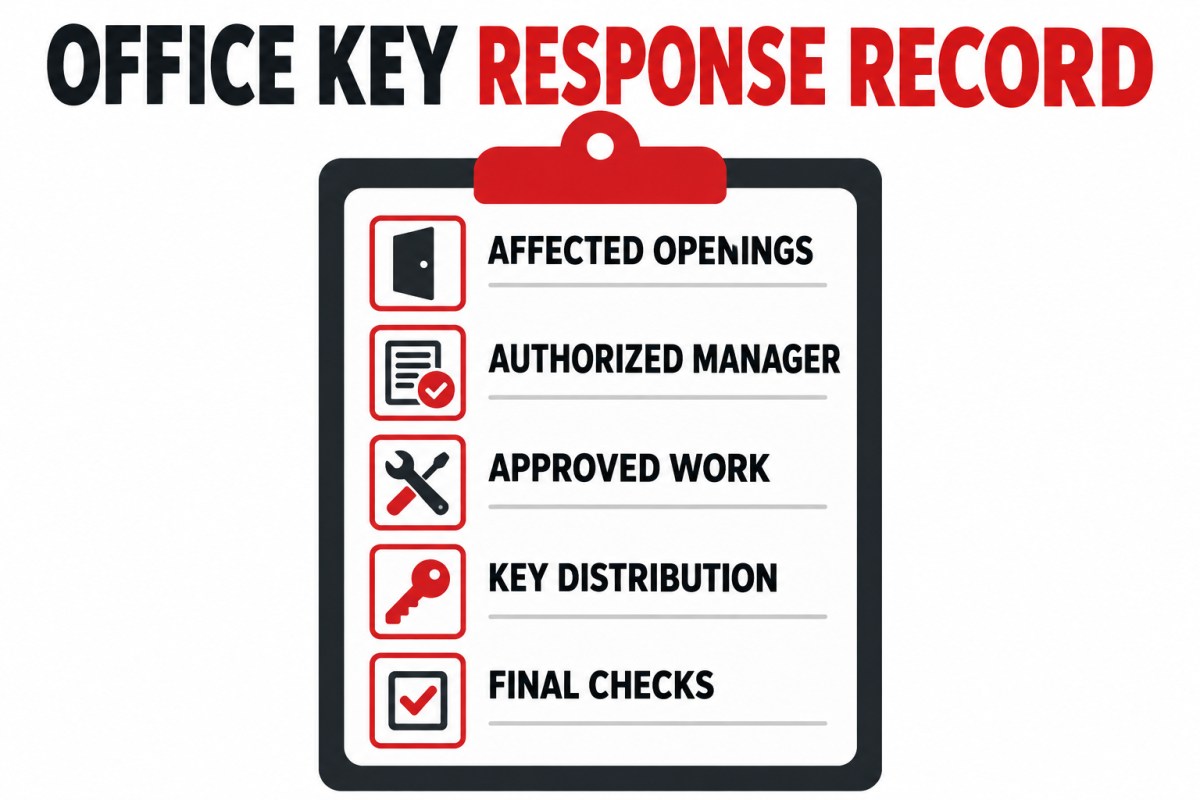
After work, identify the completed scope and the functions demonstrated. Record any remaining item, the person responsible for it, and the agreed next step. A note that the office opened is not enough to establish that all decisions arising from lost office keys have been completed. Make the distinction visible to the people who manage the premises.
Distribute replacement keys through a controlled handover after the agreed tests. Keep obsolete and current sets separated and avoid labels that reveal unnecessary access information. Tell authorized staff which set is current and who should be contacted if a key does not operate as expected. Do not let untested copies become the default spare for the next shift.
Keep the service record, approval, and key-distribution record together within the business maintenance process. Electronic credential details may belong in a separate controlled system. The purpose is not to combine every security detail in one document, but to preserve enough information to understand the authorized work and its boundaries.
Finally, review how lost office keys are reported in the future. Staff should know whom to notify and what factual information to preserve. A simple reporting route can improve the quality of the response without making claims about future losses or replacing the need to assess each incident on its actual circumstances.
Frequently Asked Questions
Do lost office keys automatically require replacing every lock?No universal response fits every loss. Identify affected openings, key history, hardware, and authority first. A provider can explain suitable options. Replacing sound hardware may not always be necessary, while changing too little can leave the original access concern unresolved. Document the chosen scope and its limits. |
Does opening the office make the missing keys harmless?No. Entry assistance restores access for authorized people; it does not invalidate a missing mechanical key. Explain whether you need both entry and an access change. Ask what prior keys remain valid after the proposed work and keep that result in the business service record. |
Who should approve work in a leased office?Coordinate with the responsible owner, landlord, or authorized property manager and check the applicable agreement and requirements. Having a key does not automatically establish authority to replace shared hardware. Give the provider the designated approval contact before arranging changes so the work follows the property process. |
What if a badge was lost with the keys?Notify the authorized access-system administrator and follow the existing credential process. Treat badge action and mechanical lock action as separate response items. Do not assume changing a cylinder disables a badge or that disabling a badge changes what an intact mechanical key can operate at the property. |
Should I share a photograph of the keyring online?Avoid posting key cuts, identifying labels, credential numbers, or detailed access information publicly. Use the organizational incident process instead. If information must be shared with a service provider, agree on an appropriate private channel and limit it to what is needed for the authorized assessment. |
Can the business keep using a spare while deciding?A spare may preserve operations, but it does not settle the concern created by the missing key. Have the responsible manager review the situation and coordinate appropriate interim arrangements. Consider the affected space and circumstances rather than letting availability of a spare end the access discussion. |
What if the keys turn up after locks have changed?Keep the recovered set separate and confirm its status against the completed service record. Do not return it to circulation without checking which openings it still operates. Recovery does not reverse an authorized access change or establish that no copies were made while the keys were missing. |
Should staff receive replacement keys before testing?Plan distribution around a confirmed handover. Test the agreed functions and supplied keys, then record who receives each copy through the business process. Avoid distributing untested keys or keeping multiple unlabeled old and new sets together, which can create confusion during the next shift or service visit. |
Can any locksmith alter our access-control system?Support depends on the installed system, provider capabilities, and authorization arrangement. Confirm product support and identify who administers the system before booking. Do not grant broad account access or share passwords merely because mechanical lock service is arranged; agree on precise work and the responsible personnel. |
What should the final incident record include?Record affected access, approval, agreed work, completion date, key or credential distribution, and unresolved items. Keep sensitive details in controlled business records. A concise handover helps future managers understand what changed without reconstructing the incident from scattered messages, unmarked key sets, or assumptions about the service. |
Final Thoughts
Lost office keys require a documented access decision as well as any entry assistance. Identify affected openings, coordinate approval, and confirm exactly what the completed work changes.
Call Tucson Locksmith Experts LLC at (520) 595-5533 or contact the team to confirm the service scope, product support, and current availability.